Rather than focusing only on large-scale infrastructure such as roads, landslides, floods, and extreme weather, Ida Hydle raised questions about everyday resilience: how climate change affects families, households, and local communities in their daily lives. This shift in perspective points to a broader understanding of sustainability. Ida also mentioned her and Jan Eriks chapter proposal for the upcoming publication from the Sámi Parliament, Sámi Figures Tell (check out our blog on that chapter). Sustainability is not only about whether bridges and roads can withstand wind and weather, but also about whether people can sustain themselves with the resources available to them. This is also a question of scale and time. Issues such as access to food, fuel, and mutual support networks become central when considering vulnerability over time.
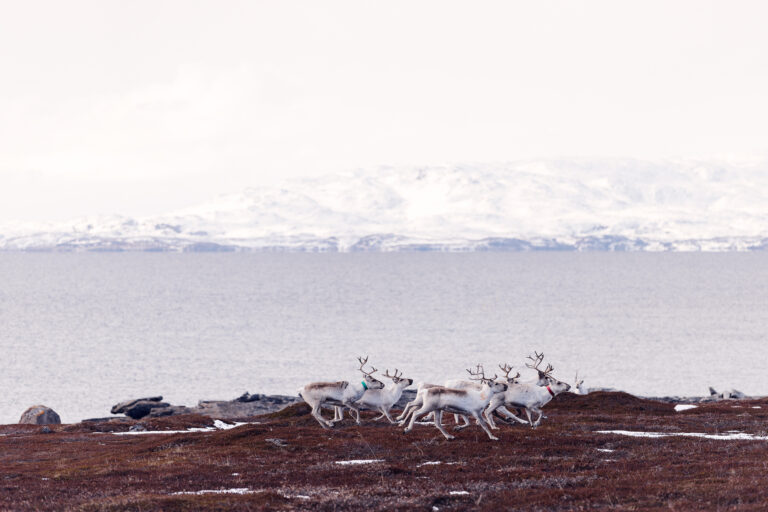
The discussion also touched on agriculture and soil erosion as a result of flooding, particularly in agricultural municipalities such as Alta, Tana, and Sør-Varanger, as well as the situation for reindeer husbandry. Ida raised important questions about the involvement of key actors and crucial rightsholders such as the Sámi Parliament and the Finnmark Estate in the vulnerability analysis for Finnmark.
Food systems emerged as a key concern. The sustainability of human communities is closely tied to the sustainability of animals and ecosystems, including reindeer, fish, marine mammals, and livestock. Ida highlighted coastal fisheries as especially vulnerable and pointed to the coastal population’s right to sustain themselves. In many Arctic coastal communities, access to fishing resources is increasingly constrained by state governance systems that allocate fishing quotas and fishing rights to large-scale ocean trawlers, often at the expense of small-scale local fishers.
In addition, environmental pressures linked to fish farming, such as pollution (sewage, poison) and sea lice, further challenge local coastal fishing practices. These overlapping pressures illustrate how climate vulnerability is not only driven by environmental change, but also by political and economic decisions. For Arctic coastal populations, including those in Finnmark, this creates compounded challenges that affect both livelihoods and cultural continuity.
The climate vulnerability analysis being developed will serve as a knowledge base for municipalities across Finnmark. This is largely based on data that the Norwegian Center for Climate Research, CICERO, gathers from various sources, including Statistics Norway (SSB) and other relevant state institutions for measuring the challenges of climate change. However, many of these municipalities face limited resources and must make difficult priorities, often focusing on immediate infrastructure needs. In this context, our BIRGEJUPMI member Ida Hydle emphasized the importance of adopting a more holistic, ecosystem-based approach. Climate-related challenges are deeply interconnected, spanning environmental, social, and economic dimensions. Addressing them in isolation risks overlooking these connections. A broader perspective could support local decision-makers in understanding how different vulnerabilities relate to one another within municipalities and across the region, both in the short and long term.
In the workshop, Ida’s contribution highlighted the value of bringing diverse perspectives into climate adaptation work and the need to expand how we understand vulnerability moving beyond infrastructure to include the lived realities of communities and their capacity to sustain themselves in times of change. Climate adaptation is not only about infrastructure; it is about people, communities, and the ecosystems that sustain them. Sustainability must consider human and ecological well-being together, and collaboration across knowledge systems is essential for effective, just decision-making. Through our BIRGEJUPMI project, we continue to combine Indigenous knowledge, local insights, and scientific research to support resilient Arctic coastal communities in an holistic way. Workshops like this, along with collaboative, engaged research and community engagement, help ensure that climate strategies reflect the lived experiences of those most affected. We invite you to follow our BIRGEJUPMI project and engage with our findings as we work toward resilient communities in the Arctic.