We add new, up-to-date theoretical perspectives and knowledges to the discussions started in the special issue Tourism and the Sámi, Scandinavian Journal of Tourism and Hospitality (vol. 6, issue 1, 2006) edited by Arvid Viken & Dieter K. Müller, the special issue Sustainable tourism and Indigenous Peoples (2016), Journal of Sustainable Tourism (vol. 24, issues 8-9), edited by Anna Carr, Lisa Ruhanen & Michelle Whitford; book Tourism and Indigeneity in the Arctic (2017) edited by Arvid Viken & Dieter K. Müller; special issue Unsettling geographies of tourism (2024), Tourism Geographies(vol. 26, issue 6, focus: settler colonialism and decolonization) edited by Bryan S. R. Grimwood, Freya Higgins-Desbiolles, tebrakunna country & Emma Lee; and book Routledge handbook of tourism and Indigenous Peoples (2024) edited by Richard Butler & Anna Carr. Indigenous/Indigeneity and Arctic have been discussed in these previous works.
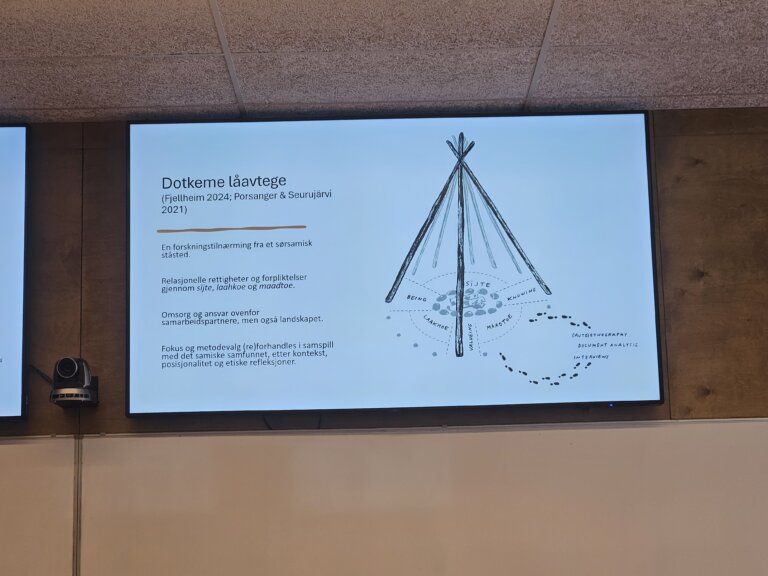
We focus on pluriversal Arctic tourism. Pluriversal as a concept has been developed in the Global (Indigenous) South and fuelled by Indigenous knowledge and decolonial theory (Escobar 2025, de La Cadena and Blaser 2018). It is a political, philosophical, and environmental concept for addressing oppression, dominance, and injustice, but also ‘a hopeful instrument for reimagining and constructing a future where plural existence is respected and celebrated’ (Pernecky 2023, 2). This special issue discusses the potential of introducing the pluriversal into Arctic tourist studies. The papers address different situated tensions concerning western and Indigenous understandings of tourism, sustainability, heritage, self and place in the Arctic. Ren et al. (2021, 117) suggest reframing culture in future Arctic and Indigenous tourism research in a way that ‘recognizes the possibility of radical ontological difference that sustains a multiepistemic literacy, a “term [that] indicates learning and dialogue between epistemic worlds. Dialogue between a diversity of epistemic worlds works to enact a “pluriversal world” a strategy for moving away from the universalizing and colonizing notion of the universe” (Kramvig and Flemmen 2019, 65)’, and acknowledging that we live in a world of many worlds (de la Cadena and Blaser 2018) For example, the Sámi are used to operate in-between two or more realities (e.g. a Sámi and a Finnish reality) (Valkonen 2023, 11). The special issue articles provide new approaches and tools for doing pluriversal tourism in the Arctic.
Guest editors:
Dr Monika Lüthje, University of Lapland, Finland
Dr Sonya Graci, Toronto Metropolitan University, Canada
Dr Britt Kramvig, UiT The Arctic University of Norway, Norway
Timelines:
Deadline for (revised) abstract submission (200 words): October 31, 2025
Abstract approvals and comments: November 15, 2025
Deadline for first draft submission: April 30, 2026
Review comments: June 15, 2026
Deadline for final paper submission: October 31, 2026
Decision from guest editors: December 31, 2026 Expected publication date: First half of 2027
References
Cadena, Marisol de la and Mario Blaser. 2018. A World of Many Worlds. Durham: Duke University Press.
Escobar, Arturo. 2025. “Against Terricide: Envisioning Paths towards Pluriversal Transitions.” Cultural Dynamics 37 (3): 236–44. https://doi.org/10.1177/09213740251363743.
Kramvig Britt and Flemmen Anne B. 2019. “Turbulent Indigenous Objects: Controversies around Cultural Appropriation and Recognition of Difference.” Journal of Material Culture 24 (1): 64–82. https://doi.org/10.1177/1359183518782719
Pernecky Tomas. 2023. “Mobilizing Relational Ontology: Meeting the Pluriversal Challenge in Tourism Studies.” Current Issues in Tourism. https://doi.org/10.1080/13683500.2023.2281599
Ren Carina, Jóhannesson Gunnar T., Kramvig Britt, Pashkevich, Albina and Höckert Emily (2021) “20 Years of Research on Arctic and Indigenous Cultures in Nordic Tourism: A Review and Future Research Agenda.” Scandinavian Journal of Hospitality and Tourism 21 (1), 111–121. https://doi.org/10.1080/15022250.2020.1830433
Valkonen Sanna (2023) “Multiple Worlds of Sámi Research.” Ethnologia Fennica 50 (1), 5–33.https://doi.org/10.23991/ef.v50i1.120070