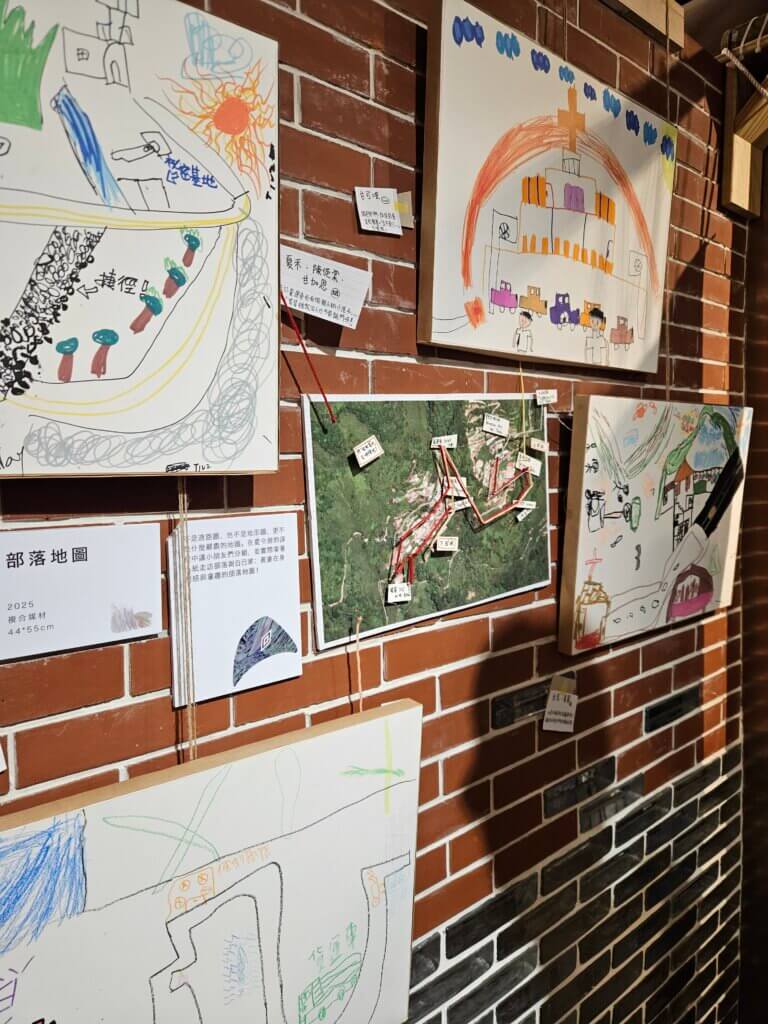
Titled ngasal maku— “my home” in the Tayal language—the exhibition grew out of a semester-long collaboration between Indigenous Tayal children and students from the Taipei National University of the Arts, many of whom are themselves of Indigenous background. The opening day became a shared moment of gathering: Tayal community members joined and offered songs that filled the space with memory and presence. Representatives from the Ministry of Forestry were also present as co-sponsors of the art programme. Their presence carried particular weight. Historically, the Ministry has symbolised state power that violently dispossessed Tayal people of their forest lands. Standing together in support of this exhibition marked a fragile yet meaningful step in the ongoing post-conflict relationship between the Tayal people and the Taiwanese state.
Birgejupmi in the Tayal territory begins with a single millet seed
Art exhibition Ngasal maku "my home" in Taipei, Taiwan brought together both Tayal community members and representatives from the Ministry of Forestry.

Contributors
Project member: Wasiq Silan
Gaga - birgejupmi in Tayal context
From 9 January to the end of February 2026, a community-based art exhibition unfolded in Taipei, Taiwan, rooted in care, listening, and deep learning. The process was facilitated by Birgejupmi project member Wasiq Silan as part of Work Package 3, working together with Tayal children, community members, and students to create a space where children’s voices could take the lead.

At its heart, ngasal maku seeks to amplify children’s perspectives—to see the world through their eyes. The exhibition builds on a student-organised children’s arts programme in the Mknazi River valley, where learning takes place alongside millet farming practices carefully sustained over many years by Millet mama Pagung Tomi. Children and university students shared the processes of sowing, thinning, and harvesting millet—practices that resonate deeply with birgejupmi, understood in line with the Tayal context as Gaga, Tayal law and way of life.
Through this embodied process, Gaga is not taught as an abstract concept but lived through the body: hands touching soil, feet sensing the warmth of the land, and time measured through cultivation and growth. The children cultivated Tayal culture and millet planting, while the students learned from the children and facilitated artistic processes that allowed the children to confidently express their own understandings of home.

This exhibition was more than a presentation of artworks; it became a journey of reflection and becoming. Along the way, children, university students, and community members came together to slowly shape the curatorial ideas through shared experiences, conversations, and creative acts. From a single millet seed, a beginning was planted—gently nurturing an awareness of home. Step by step, this awareness grew into a path shaped by memories and lived moments, eventually becoming resilient millet carrying deep affection for community and land.
The exhibition also carries a strong decolonial relevance through its location. The building in which it took place once functioned as a storage house during Japanese colonial rule, used to store natural resources extracted from Tayal homelands over a century ago. By inviting children and community members into this space today, those who were once objectified and dispossessed gained the opportunity to speak and be present. In this context, art becomes more than expression—it becomes a method of decolonisation, transforming a site of extraction into a space of care and shared futures.

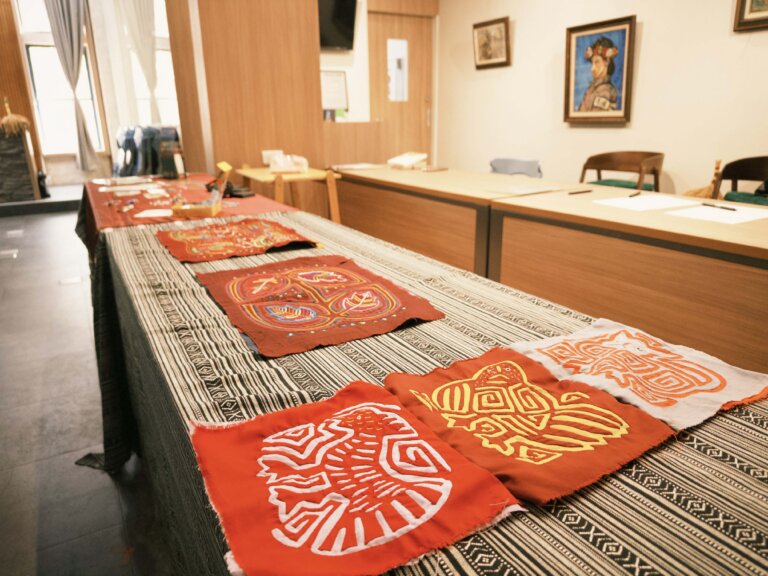
In addition to ngasal maku, a side exhibition extends birgejupmi beyond Tayal territory. This accompanying display introduces Millet mama Pagung Tomi and traces connections formed through the project’s transnational exchanges, including the Birgejupmi team’s visit to Panama. The side exhibition features mola textile pieces by the Kuna people, alongside stories and a small photovoice exhibition created by project members who took part in the Panama visit. Through photographs, texts, and reflections—including those by Wasiq Silan—the exhibition shares how ideas of health and wellbeing were sensed and reimagined throughout the collective process. Together, these works situate millet, care, and Indigenous knowledge within a wider network of relations, highlighting birgejupmi as a practice that grows through encounter across territories.
Relevant news and publications
-
Presentations on ‘birgejupmi’ at National Dong Hwa University
Published: 13.02.2026NewsProject member Wasiq Silan organised a student engagement presentation at the National Dong Hwa University for sharing experiences from the UN Convention held in Panama in 2025.
Read more -
BIRGEJUPMI at Pukkellaks 2026
Published: 15.01.2026NewsJan-Erik Henriksen and Ida Hydle attended the Pukkellaks 2026 seminar.
Read more -
Britt Kramvig’s article on Miärralándda
Published: 13.01.2026NewsBritt Kramvig's and Tarja Tuulia Salmela's new article "When the land becomes the sea and the sea becomes the land: Disrupting processes of appropriation of Miärralándda" has been published in the Journal Environment and Planning E: Nature and Space.
Read more