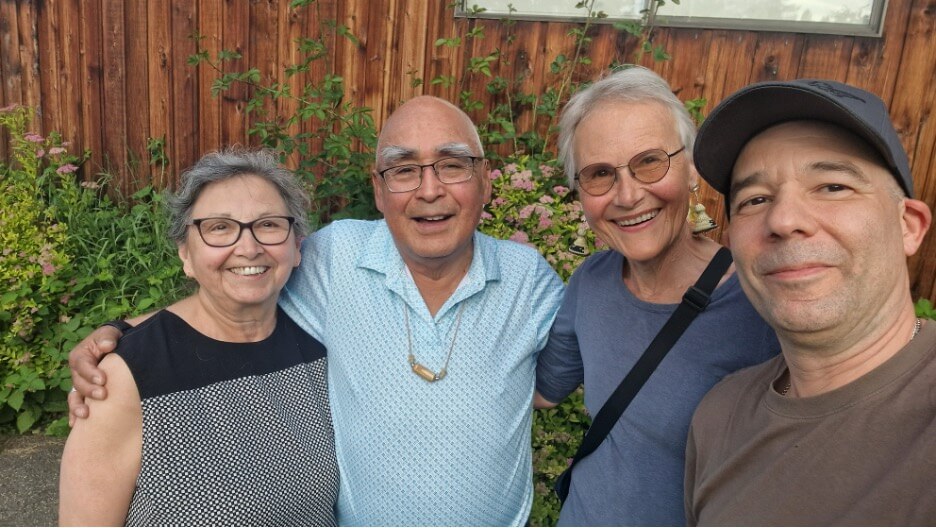
Ida and Stephan were welcomed with extraordinary generosity. Matilda shared food from a recent family gathering, including smoked salmon prepared by relatives, while both she and Clifford introduced us to family heirlooms, baskets, masks, jewellery, and other handcrafted objects passed down through generations. Their home reflected the importance of family, memory, and cultural continuity.
A central theme of their conversation was salmon. For Clifford, salmon are not simply a resource but the foundation of community life, identity, and responsibility. He spoke about the dramatic decline of salmon populations and the many pressures affecting them, including industrial fisheries, fish farming, forestry, habitat degradation, and climate change. At the same time, he emphasized that salmon connect rivers, oceans, communities, and nations, making their protection both an ecological and a political challenge.
Drawing on decades of activism, Clifford reflected on the long struggle for Indigenous fishing rights on the west coast; about negotiations, agreements, and court battles, but also about the frequent gap between political promises and implementation. Despite these frustrations, his message was not one of resignation. Rather, he stressed the importance of persistence, collective action, and long-term commitment.
An important part of the conversation focused on Indigenous governance and knowledge. Clifford argued that Indigenous knowledge should not merely be consulted but treated as an equal partner alongside scientific expertise. Decisions about salmon and ecosystems, he suggested, require both local experience and scientific understanding. One topic that particularly resonated with him was the Declaration of Indigenous Salmon Peoples, signed in Karasjok. He spoke about the declaration with great appreciation and considered it an important document that should be shared more widely and used for education and collaboration. He saw it as an expression of common responsibilities among Indigenous peoples whose lives and cultures are connected to or dependent upon salmon. His strong support for the declaration encouraged us to continue building connections and exchanges across Indigenous salmon regions.
What Ida and Stephan learned from Clifford and Matilda extends far beyond fisheries policy. Often the conversation returned to responsibility: responsibility toward ancestors, future generations, rivers, salmon, and community. Their reflections demonstrated that governance is not simply a matter of institutions and regulations but also of relationships, knowledge, and accountability.
Clifford’s lifelong commitment to Indigenous rights and Matilda’s dedication to community wellbeing offered a powerful inspiration that meaningful change is built through persistence, generosity, and care for future generations.