This is the second blog in Ida Hydle’s series from Karasjok, where she follows the ongoing court case as an anthropologist. The case raises fundamental questions about who should hold ownership and stewardship rights over the land, waters, and rivers of Karasjok Municipality, including rights to hunt, fish, and harvest. At stake is whether these rights belong to the local population or the state. Karasjok is Norway’s second-largest municipality, covering approximately 5,000 square kilometres.
Finnmark, which the Norwegian state authorities themselves referred to as a colony at the beginning of the twentieth century, occupies a completely different legal position under Norwegian legislation from the rest of the country. The historical reference to Finnmark as a colony remains significant. Today, land in the region is owned and administered by FeFo (Finnmarkseiendommen), known in English as the Finnmark Estate. Although FeFo is an independent legal entity rather than a government department, many people in Karasjok perceive it as an extension of the Norwegian state. From this perspective, the relationship between Sámi communities and state institutions continues to reflect the legacy of forced Norwegianisation, albeit in different forms today.
With approximately 96% of Karasjok’s population identifying as Sámi, the case also raises important questions concerning international law and Indigenous peoples’ rights. In 1990, Norway ratified ILO Convention No. 169 on Indigenous and Tribal Peoples, recognising its obligations towards Indigenous peoples. The Norwegian Constitution also recognises the responsibility of the state to create conditions enabling the Sámi people to preserve and develop their language, culture, and way of life. International law is therefore an important framework for addressing Sámi rights to land, water, and traditional livelihoods.
But the law is one thing, and the governments practice is another. The recognition of rights in law does not always translate into practice. Cases such as Fosen, Melkøya, and Øyfjellet illustrate the continuing tensions between state policies, industrial development, and Sámi rights. These disputes have raised serious concerns about the protection of Sámi interests, the implementation of legal safeguards, and, in particular, the follow-up to court decisions concerning Indigenous rights.
The Karasjok case has been heard three times: twice by the Finnmark Land Tribunal, which is Finnmark Estate’s (the state’s) own court for land disputes, and once by the Supreme Court, which is the appellate court for the Finnmark Land Tribunal. In 2024, the Supreme Court, ruled by six votes to five that the Finnmark Estate – the state – should continue to own and administer Karasjok Municipality. Nevertheless, it sent the case back to the population, asking it to eventually divide Karasjok into smaller areas with a suggestion that the local population groups of Karasjok should appeal to the FInnmark Land Tribunal once more.
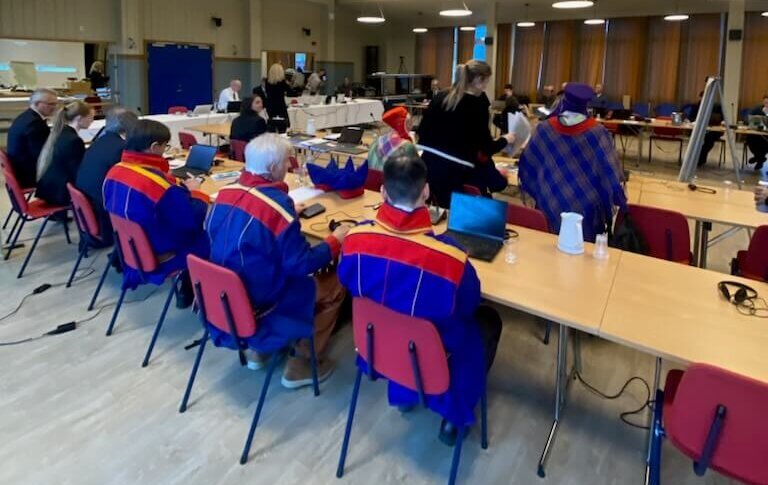
The Sámi village associations in Karasjok have joined together and agreed to bring the case before the Finnmark Land Tribunal once again. That is where we are today. The court proceedings are taking place from 6. to 30. October at the Karasjok Community Centre, and our BIRGEJUPMI WP5 member Ida Hydle sit in the public gallery every day, listening to the lawyers and speaking with people during the breaks and taking notes on highly interesting facts about the Sámi and their relationship with, in historical succession, the Swedish, Danish-Norwegian and Norwegian states – from the fifteenth century to the present day – as presented by the lawyers in the case. There is also documentation showing that the Sámi were here first, with evidence dating back 2,000–3,000 years.
None of this is being reported in Norway’s major newspapers, barely a sentence or a picture in the TV’s.
On 9 October, the lawyers representing the Karasjok village associations presented the meaning of birgejupmi in Sámi language and as a worldview. Birgejupmi brings together Sámi cosmological and ontological understandings, expressed through everyday practices, traditions, and relationships with the surrounding world. The concept is central to understanding what is at stake in the Karasjok case. It highlights the interdependence between communities, shared resources, and their environments, as well as the responsibilities involved in caring for these relationships. This care encompasses humans and non-humans alike, recognising the connections between people, land, waters, and other living beings.
For our BIRGEJUPMI project, it is particularly significant to see the concept at the heart of such a remarkable court proceeding. A term central to our research has become part of a wider legal discussion about Sámi land rights, collective stewardship, and the relationships between Indigenous communities and their territories. This offers an important opportunity to reflect on how Sámi worldviews and understandings of care can inform legal debates about land, rights, and responsibility.