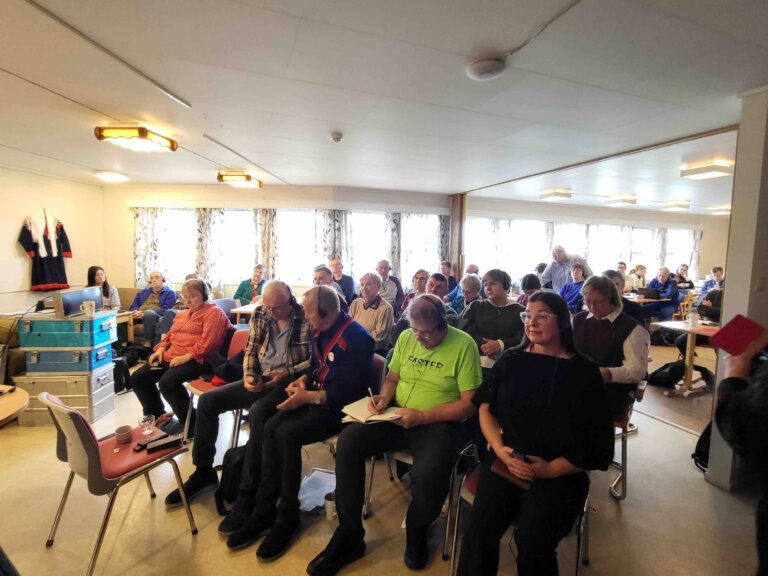
Moderated by Aslak Holmberg, former President of the Saami Council, the panel discussion invited participants to reflect on the following question:
“How can Indigenous River peoples work to take care of their home rivers, and further the rights of both rivers and people through international cooperation? During the 2024 Indigenous Salmon Peoples Gathering, an Indigenous Salmon Peoples’ Declaration (the Kárášjohka Declaration IISPN – Karasjok Declaration) was created to state the importance of salmon as the basis for Indigenous salmon peoples’ future wellbeing. What are the most effective ways to get governments to listen and act on the various items of the declaration? What means can be used to achieve acknowledgement of the rights of rivers and river peoples both locally and at the international scene?”
The panel discussion was co-organized by the Arctic University of Tromsø (UiT) and the Sharing Our Knowledge project, the International Indigenous Salmon Peoples Network, and Riddu Riđđu. The participants had been key to developing the Karasjok Declaration. The panel was asked to come up with viable future solutions with the Riddu audience. The participants were Jon-Christer Mudenia (the Sámi Parliament of Norway), Dr. Shelley Denny (Mi’kmaw Nation inhabiting Unama’ki; Unama’ki Institute of Natural Resources/UINR), Miyuki Daorana (Arctic Council Indigenous Peoples´ Secretariat), Autumn Adams (Yakama Nation), Maggie Mills, IISPN (International Indigenous Salmon Peoples´ Network) and Ida Hydle (UiT) and the Birgejupmi project (Birgejupmi.eu).
Ida Hydle presented results from Birgejupmi fieldwork highlighting the multi-faceted crisis threatening Atlantic salmon, coastal Sámi fishing cultures, and Arctic coastal ecosystems. This crisis cannot be reduced to a single cause such as the pink salmon (pukkellaks) invasion. Norwegian authorities have responded with large-scale barriers and removeal of pink salmon in 63 rivers and to the costs of Norwegian Kroner 72 million in 2025 (7,2, Mill Euro). In addition, they have banned salmon fishing closures in both fjords and rivers. This is comparable to the fishing ban for seven years in the Yukon River by Canadian and US state authorities. However, fieldwork and cross-disciplinary evidence point to a complex, cumulative set of pressures and: pelagic trawl and purse-seine fisheries that remove small pelagic species, unreported bycatch of adult salmon, impacts from industrial aquaculture such as sea‑lice, fish sewage, escapes and genetic introgression, habitat damage from bottom trawling, including lost coral reefs, northward transport of pollutants via coastal currents, and above all inadequate state interagency coordination, knowledge based control and governance. Traditional sea‑ and river‑salmon fishing is a living cultural foundation for coastal Sámi communities as with all Indigenous River peoples across the Arctic. Blanket bans risk subsistence and cultural loss – practices and languages. This serious situation calls for ecosystem-based management that centers Indigenous Knowledge, permits limited subsistence fishing, mandates full ocean trawlers and purse‑seine catch reporting and on‑board observers on ocean and purse‑seine trawlers. In addition, there is a need to establish no‑trawl/no‑ purse‑seine zones 24 nautical miles outside fjords. Overall, there is a need to strengthen cross‑state ministerial cooperation with Indigenous rightsholders and traditional knowledge holders and Arctic and Northern cross-Indigenous cooperation and knowledge exchanges, such as the BIRGEJUPMI project is an example of.